111-01 Queens
Boulevard,
Forest Hills, NY 11375


Latest Posts
How Guided Implants Work for a Predictable Smile
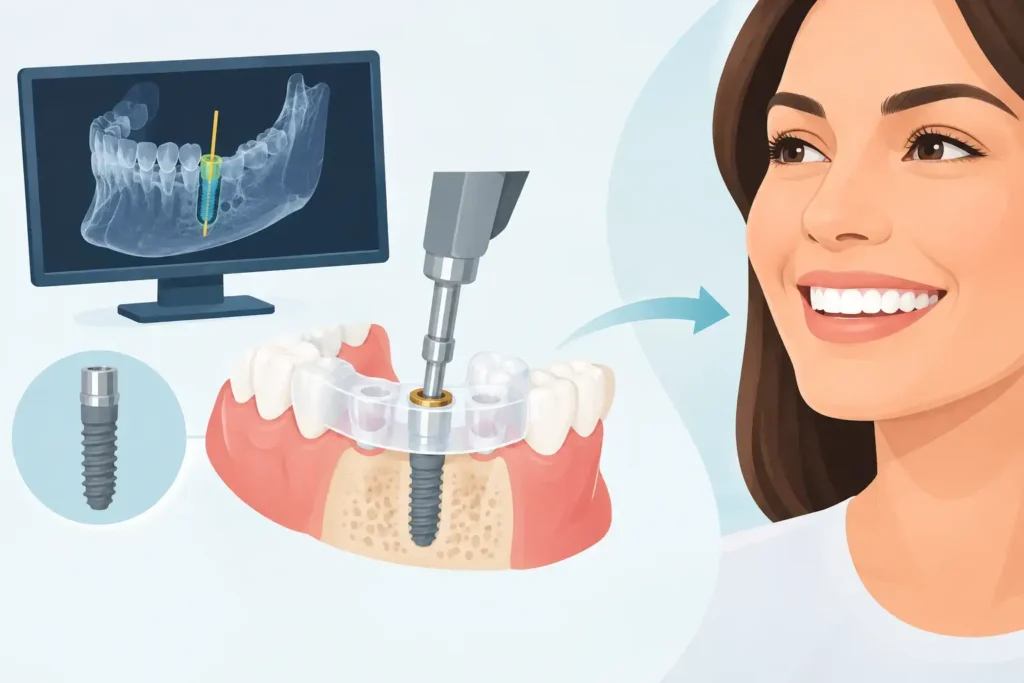
A missing tooth can affect more than the way you eat or smile in photos. It can change how you speak, put added pressure on neighboring teeth, and gradually affect the bone that supports your facial structure. Understanding how guided implants work can make a major treatment feel more manageable: the process uses detailed digital planning to place an implant with a clear, personalized roadmap.
For many patients, that extra planning brings welcome peace of mind. Guided implant surgery is not a different type of implant. It is a technology-guided approach to placing a dental implant precisely, based on your individual anatomy, bite, and long-term restoration plan.
How Guided Implants Work Step by Step
A dental implant replaces the root of a missing tooth. It is a small, biocompatible post, usually made of titanium, that is placed in the jawbone. Once it heals and bonds with the bone, it can support a custom crown, bridge, or implant-retained denture.
With traditional implant placement, the dentist evaluates X-rays and clinical measurements, then places the implant using that information during surgery. Guided surgery adds a detailed digital planning phase before treatment begins. The goal is to determine the ideal position before the appointment, rather than making key positioning decisions only at the time of surgery.
1. A complete evaluation comes first
Every successful implant plan starts with a careful examination. Your dentist reviews your medical and dental history, evaluates your gums and bite, and considers the condition of surrounding teeth. This is also the time to discuss your goals. Replacing one visible tooth calls for a different plan than stabilizing a full denture or rebuilding several missing teeth.
Digital X-rays and 3-D cone beam imaging provide a detailed view beneath the gumline. These images show the height, width, and density of the available bone, as well as nearby structures such as the sinus cavity in the upper jaw and nerves in the lower jaw. This information helps your dental team determine whether an implant is appropriate and whether procedures such as bone grafting may be needed first.
A healthy mouth matters. Active gum disease, untreated decay, or an infection should be addressed before implant surgery. Patients who smoke, clench or grind their teeth, have poorly controlled diabetes, or take certain medications may still be candidates, but their plan may require added precautions and closer follow-up.
2. Your smile is planned digitally
Next, a digital scan captures the shape of your teeth and gums. This scan can be combined with the 3-D imaging to create a virtual model of your mouth. Your dentist can plan the implant in relation to the final tooth restoration, not simply the open space in the bone.
That distinction is meaningful. An implant needs sufficient bone support, but it also needs to emerge in a position that allows a crown to look natural, fit comfortably, and meet the opposing teeth correctly. Planning from the final restoration backward is often called restorative-driven implant planning.
Using specialized software, the dentist selects the implant’s size, depth, angle, and position. The plan accounts for the root spaces of adjacent teeth, the gumline, bone contours, and important anatomical structures. For a bridge or full-mouth restoration, the digital plan also helps coordinate the placement of multiple implants so they can support the proposed teeth appropriately.
3. A surgical guide is made for your treatment
Once the virtual plan is approved, a custom surgical guide may be created. This is a small, clear device that fits securely over your teeth, gums, or existing denture. It includes precisely positioned openings that guide the surgical instruments according to the digital plan.
Think of it as a tailored template. It does not replace the dentist’s training, judgment, or ability to adjust when clinically necessary. Instead, it transfers the carefully developed plan into the surgical setting with greater consistency.
Not every implant case requires the same kind of guide. In some situations, a guide may direct the initial drilling only. In others, it may guide multiple steps of implant placement. The right approach depends on the location of the missing tooth, the amount of bone available, whether teeth are still present, and the complexity of the restoration.
4. The implant is placed with a clear roadmap
On the day of surgery, the area is numbed for your comfort. Sedation options may also be discussed when appropriate. The surgical guide is seated and checked for stability before it is used to direct the placement process.
Because positioning has been mapped in advance, guided surgery can often support a more efficient and conservative procedure. In select cases, it may allow for a smaller incision or a flapless approach, meaning the gum tissue is not lifted in the same way as with some traditional procedures. That can reduce swelling and improve comfort for some patients, but it is not automatically the best choice for every mouth.
The implant is then placed in the planned location. Depending on the stability of the implant, your bite, and the type of restoration needed, a temporary tooth may be possible. Other patients will need a healing period before a crown or denture is attached. Immediate teeth are not the same as immediate full function, so following instructions about diet and pressure on the implant remains essential.
Healing Is Where the Implant Builds Its Foundation
After placement, the jawbone gradually integrates with the implant through a process called osseointegration. Over the next several months, bone cells attach to the implant surface and form a stable foundation for the final restoration.
Healing times vary. A patient with strong bone and a straightforward single-tooth case may progress differently than someone receiving several implants, a bone graft, or full-mouth rehabilitation. Your dentist monitors healing with follow-up visits and imaging as needed, rather than relying on a calendar alone.
During this stage, good home care protects your investment. You may receive specific instructions about brushing, rinsing, eating softer foods, taking prescribed medications, and avoiding tobacco. Temporary restorations should be treated carefully. Even when they look like finished teeth, the implant below is still healing.
The Final Crown, Bridge, or Denture Completes the Plan
When the implant has healed adequately, your dentist takes a digital scan or impression to create the final restoration. For a single tooth, this is often a custom crown designed to match the shape, color, and character of surrounding teeth. For several missing teeth, the final restoration may be a bridge or a fixed, implant-supported denture.
The restoration is carefully adjusted so it feels comfortable when you bite and speak. A well-designed result should be functional, natural-looking, and easy to clean with the techniques recommended by your dental team.
An implant cannot get a cavity, but the gums and bone around it still need protection. Daily brushing, cleaning between teeth or around the restoration, professional cleanings, and periodontal maintenance are part of long-term implant care. Regular visits also allow your dentist to check the bite, restoration, gums, and supporting bone before small concerns become larger ones.
Why Digital Guidance Can Matter
The primary benefit of guided implant surgery is precision in planning and placement. By evaluating your anatomy and the final restoration together, your dentist can work toward an implant position that supports both health and appearance.
Guidance may be especially valuable when space is limited, when implants are near sensitive anatomical structures, or when several implants must work together to support a bridge or permanent denture. It can also make the process feel more predictable for patients who appreciate seeing a detailed plan before treatment begins.
Still, guided surgery is not a promise of a painless procedure, instant healing, or identical results for every patient. The quality of your bone, gum health, overall health, bite forces, and commitment to ongoing care all influence the outcome. In some cases, conventional placement or a combination of guided and conventional techniques may be the most appropriate clinical choice.
Questions to Bring to Your Implant Consultation
A thoughtful consultation should leave you with a clear sense of the recommended path. Ask whether you have enough healthy bone, whether grafting is needed, what type of final restoration is planned, and whether you may qualify for a temporary tooth. It is also reasonable to ask about expected healing, home care, costs, and the number of appointments involved.
For Queens patients balancing work, family, and dental care, a digitally planned implant process can make complex treatment easier to understand and coordinate. At Renaissance Dental Forest Hills, the focus is on creating a plan that respects your health, comfort, schedule, and long-term smile.
The best next step is not to assume that a missing tooth has to stay missing or that every implant experience is the same. A personal evaluation can show what is possible in your mouth and give you a practical path toward eating, speaking, and smiling with greater confidence.
Comments are closed.
Proudly serving the surrounding areas:
Forest Hills NY • Queens NY • Rego Park NY • Kew Gardens NY • Maspeth NY
Middle VIllage NY • Woodside NY • Sunnyside NY • Jamaica Estates NY • Queens County NY