111-01 Queens
Boulevard,
Forest Hills, NY 11375

Latest Posts
Implant Supported Dentures Comparison for Queens
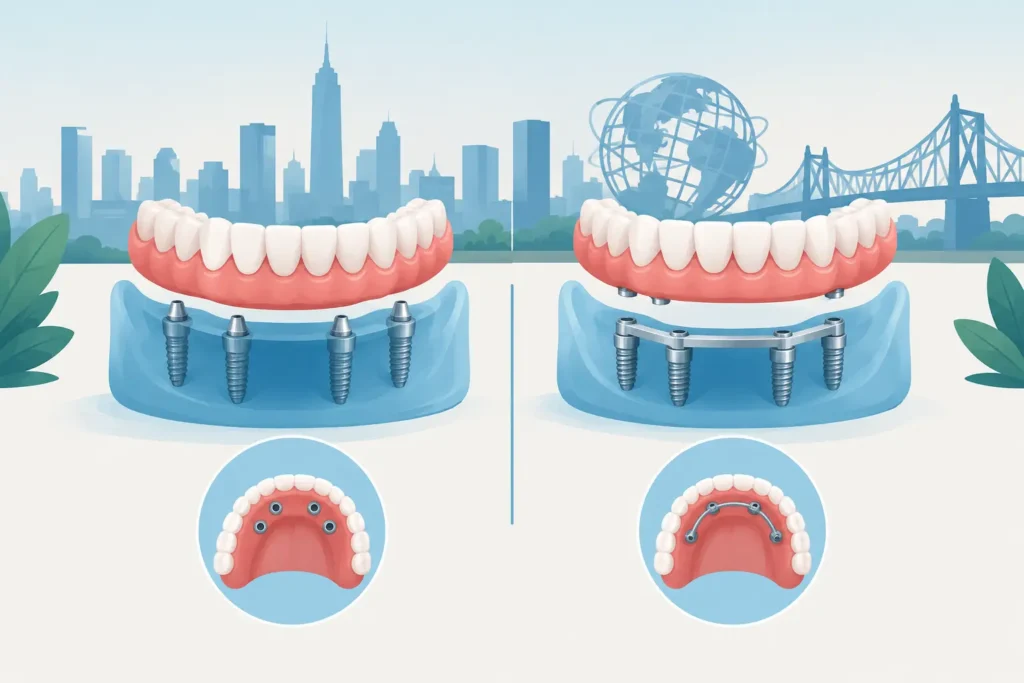
A denture that shifts when you speak, presses on sore gums, or makes favorite foods difficult can affect far more than mealtimes. An implant supported dentures comparison helps clarify why some replacement options feel more secure and natural than others – and which approach fits your health, goals, schedule, and budget.
For adults in Forest Hills and throughout Queens, the decision is rarely just about replacing missing teeth. It is about being able to eat comfortably at a family dinner, speak with confidence at work, and smile without worrying that a denture will move. Dental implants can create a stronger foundation for a full arch of replacement teeth, but the right design is personal.
Implant Supported Dentures Comparison: The Main Choices
Traditional full dentures rest directly on the gums. They are removable, do not require surgery, and can be an appropriate solution for many patients. However, the lower denture in particular may move because the tongue and limited gum surface make it harder to stabilize. Adhesives can help, but they do not change the underlying fit or prevent gradual bone loss in the jaw.
Implant-supported dentures use dental implants placed in the jawbone as anchors. Once implants have integrated with the bone, they can support a removable denture or a fixed full-arch restoration. The number and position of implants depend on your anatomy, bite, bone quality, and the type of restoration being planned.
You may hear the terms “implant-retained” and “implant-supported” used interchangeably. In a strict clinical sense, an implant-retained denture often snaps onto implants but still rests partly on the gums. An implant-supported prosthesis receives more of its support from the implants themselves. Both can offer meaningful improvement over a conventional denture, and your dentist can explain the design being recommended.
Conventional dentures
A conventional denture is generally the most straightforward and least surgical option. It can be made after teeth have been removed and the gums have healed, or it can sometimes be placed immediately after extractions as a temporary solution while healing continues.
The trade-off is stability. Even a well-made denture can loosen over time as the jaw changes shape. It may need periodic adjustments, relines, or replacement to maintain a comfortable fit. This option can make sense for patients who prefer to avoid implant surgery, have medical considerations that require a more conservative plan, or need a lower initial cost.
Removable implant-retained dentures
A removable implant-retained denture attaches to implants through connectors, often called snaps or attachments. You remove it at home for cleaning, but it stays far more securely in place during daily activities than a conventional denture.
For many people, especially those with a loose lower denture, this option is a practical middle ground. It can improve chewing ability, reduce rubbing and movement, and provide added confidence when talking and laughing. Because the denture comes out, you can clean the appliance and the implants directly.
Attachments and housings can wear with normal use and may need maintenance over time. The denture may still have some contact with the gums, so gum tissue and fit remain important. It is a strong choice for patients who want stability without committing to a permanently fixed restoration.
Fixed full-arch implant dentures
A fixed full-arch implant restoration is secured to several implants and can only be removed by a dental professional. It is often called a permanent denture, although the restoration and its components still require professional maintenance and may eventually need repair or replacement.
Because it is firmly attached, a fixed option can feel especially stable for eating and speaking. It is designed to resemble a full set of teeth and is not removed at night. Many patients appreciate the sense of security, but it also requires a consistent cleaning routine underneath the restoration. Specialized brushes, flossing tools, or oral irrigators may be recommended.
A fixed restoration usually involves more treatment planning, surgery, and investment than a removable option. It also requires enough healthy bone and a bite design that protects both the implants and the final teeth. In some cases, bone grafting, periodontal treatment, or tooth extractions may be part of the plan before implants are placed.
How Comfort, Function, and Maintenance Differ
The best choice is not always the one with the most implants or the most fixed design. Comfort depends on how the restoration fits, how your bite is balanced, the health of your gums, and how well you can maintain the result at home.
A conventional denture is easy to remove and clean, but it can be less stable. A removable implant-retained denture improves security while preserving the familiar ability to take the appliance out for cleaning. A fixed full-arch restoration offers the greatest day-to-day stability, but cleaning beneath it takes more technique and commitment.
Chewing expectations should be realistic. Implant support can make it easier to enjoy a wider range of foods, but every restoration has limits. Very hard foods, ice, or habits such as chewing pens can damage denture teeth or place excess force on implants. Your dentist will help you understand how to protect the restoration you choose.
Speech also improves differently for each person. A traditional upper denture covers much of the palate, which can affect speech or taste initially. Some implant designs may reduce palate coverage, but the specific design depends on your arch, implant positions, and need for support. There is always an adjustment period, and most patients benefit from patience and follow-up adjustments.
What Determines Whether You Are a Candidate?
Good implant candidates are not defined by age alone. The most relevant factors are overall health, gum health, bone volume, oral hygiene habits, and the ability to attend follow-up visits. Patients with diabetes, osteoporosis, a history of periodontal disease, or certain medications may still be candidates, but treatment planning should account for those details.
Smoking and untreated gum disease can increase the risk of implant complications. So can uncontrolled teeth grinding. If you clench or grind, a protective night guard may be part of preserving your investment. A thorough evaluation may include digital imaging, a review of your medical history, and a discussion of the teeth you have now, not only the teeth you are missing.
If teeth need to be removed, timing matters. Some patients may receive implants at the time of extraction, while others benefit from a healing period first. A temporary denture may be used during healing. The safest timeline is the one based on your biology and treatment needs, rather than a one-size-fits-all schedule.
Comparing Costs Without Missing the Bigger Picture
Implant-supported dentures cost more upfront than traditional dentures because they include surgical planning, implant placement, components, the final denture or bridge, and ongoing follow-up. The final cost can also be affected by extractions, bone grafting, sedation, imaging, and the materials selected.
It is helpful to compare complete treatment plans rather than only the first quoted number. Ask what restoration is included, whether temporary teeth are part of the plan, what maintenance may be needed, and how future repairs are handled. A removable implant-retained denture may have a lower initial investment than a fixed option, while a fixed design may offer more stability for patients with the right clinical needs.
Long-term value also includes time, comfort, and confidence. A plan that is easy to keep clean and realistic for your daily routine is often more valuable than a more complex option that becomes difficult to maintain.
Planning a Result That Feels Like You
Successful implant treatment starts with listening. Your dentist should ask what bothers you about your current denture, what foods you miss, whether appearance or stability is your top priority, and how much daily maintenance feels manageable. Those answers help shape a recommendation that supports your health as well as your lifestyle.
At Renaissance Dental Forest Hills, guided implant planning can help the team evaluate implant placement carefully and coordinate each phase of full-mouth restoration. The goal is not to push every patient toward the same solution. It is to create a treatment plan that is comfortable, understandable, and designed for lasting function.
If your current denture no longer feels secure, a consultation can turn uncertainty into clear choices. Bring your questions, your medical history, and an honest description of what you want to change. The right denture should support the life you want to live, from a quick lunch in Queens to a relaxed meal with the people you love.
Comments are closed.
Proudly serving the surrounding areas:
Forest Hills NY • Queens NY • Rego Park NY • Kew Gardens NY • Maspeth NY
Middle VIllage NY • Woodside NY • Sunnyside NY • Jamaica Estates NY • Queens County NY