111-01 Queens
Boulevard,
Forest Hills, NY 11375
Latest Posts
- Full Mouth Dental Implants Cost: What Affects It
- Is Laser Treatment for Gum Disease Right?
- Multilingual Dentist Forest Hills for Your Family
- Teeth Whitening for Sensitive Teeth Safely
- Permanent Dentures Versus Implants Compared
Archives
Permanent Dentures Versus Implants Compared
A missing tooth can change more than a smile. It can make a favorite meal harder to enjoy, affect speech, and cause nearby teeth to shift over time. When patients ask about permanent dentures versus implants, they are often looking for one clear answer. The better choice depends on how many teeth are missing, the health of the jawbone and gums, daily comfort priorities, and the kind of long-term care that fits their life.
At Renaissance Dental Forest Hills, treatment planning starts with the person, not the product. A careful exam and digital imaging help determine which solution can restore function, appearance, and confidence safely.
What “permanent dentures” usually means
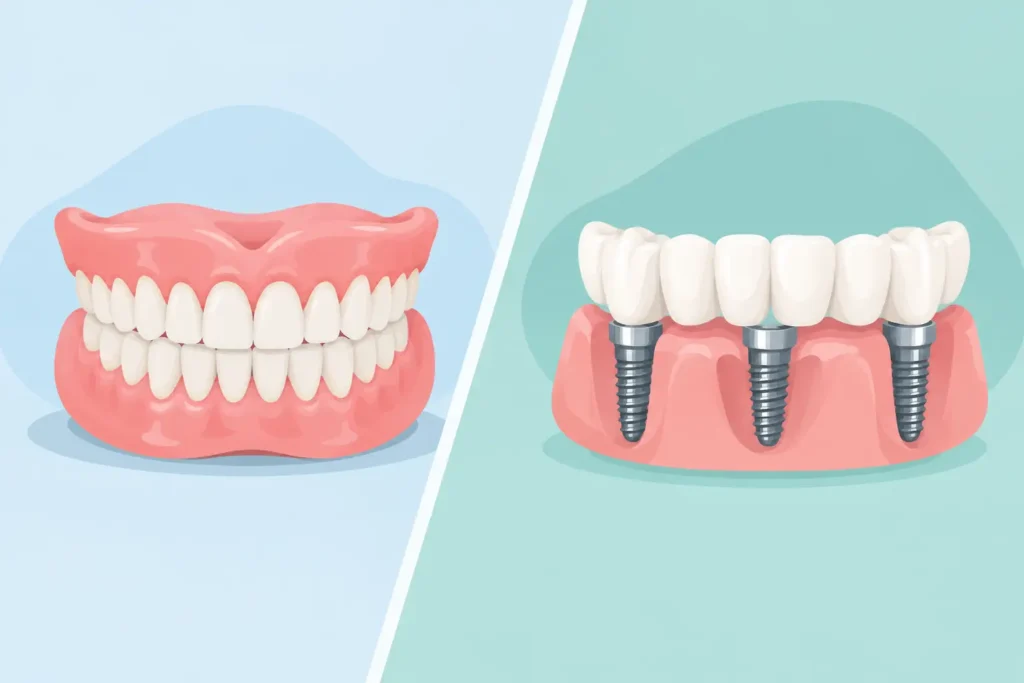
The term permanent dentures can be confusing because it is used for more than one treatment. Traditional full dentures are removable. They rest on the gums and are taken out for cleaning. They may be an appropriate option for some patients, but they are not permanently attached.
Most often, permanent dentures refers to a full arch of replacement teeth that is fixed to dental implants. The teeth are secured in place by a dentist and are not removed at home. You may also hear this called a fixed implant bridge, full-arch implant restoration, or implant-supported denture.
This distinction matters. A fixed full-arch restoration uses implants, so the question is frequently not simply dentures or implants. It may be a choice between replacing each missing tooth with an individual implant or using several implants to support a complete, fixed set of teeth.
Dental implants: replacing one tooth at a time
A dental implant replaces a missing tooth root with a small biocompatible post placed in the jawbone. After healing, an abutment and custom crown are attached. The result looks and functions much like a natural tooth.
For a single missing tooth, an implant with a crown is often the most conservative fixed solution because it does not require filing down neighboring healthy teeth, as a traditional bridge typically does. Implants can also replace several missing teeth, either as individual implants or as support for a bridge.
Benefits of individual implants
Individual implants offer a natural feel, a stable bite, and straightforward daily hygiene. You brush and floss around them much as you would natural teeth, although your dentist may recommend specific floss threaders or small interdental brushes.
They also help preserve jawbone. When a tooth root is missing, the bone in that area can gradually shrink because it no longer receives normal chewing stimulation. An implant transfers chewing forces to the bone, which can help maintain facial support and oral function.
The trade-off is treatment time and cost. Each implant site needs adequate bone, healthy gum tissue, and careful planning. If several teeth are missing, replacing every tooth individually can be more involved and more expensive than using a smaller number of implants to support a bridge.
Permanent dentures: fixed teeth for a full arch
A fixed implant-supported denture is designed for someone missing most or all teeth in the upper jaw, lower jaw, or both. Instead of placing an implant for every missing tooth, a carefully planned number of implants support a full set of replacement teeth.
Because the restoration is secured in place, it does not move like a removable denture can. Patients often find that this stability makes eating, speaking, and smiling feel more comfortable and predictable. The teeth are shaped and color-matched to create a natural-looking smile while restoring chewing ability.
When permanent dentures can make more sense
Permanent dentures may be a strong option when multiple teeth are failing due to extensive decay, gum disease, fractures, or long-term wear. They can also help patients who are frustrated by loose removable dentures or adhesive creams.
In some cases, strategically positioned implants can avoid the need to replace every missing tooth individually. This approach can be especially useful when a patient needs full-mouth rehabilitation and wants fixed teeth rather than a removable appliance.
However, a full-arch restoration is still a significant treatment. It requires detailed planning of bite alignment, gum health, bone volume, facial support, and the design of the final teeth. A restoration should never be selected based on speed or appearance alone.
Permanent dentures versus implants: key differences
The most useful comparison is not which option is “better” in general, but which one best matches the condition of your mouth.
An individual implant is typically ideal when one or a few teeth are missing and the remaining teeth are healthy enough to keep. It allows targeted replacement and preserves the natural teeth around the gap. A fixed implant-supported denture is generally more appropriate when an entire arch needs replacement or when remaining teeth have a poor long-term outlook.
Both options are fixed, stable, and supported by the jawbone. Both need daily home care and routine professional maintenance. The difference is scale: individual implants replace specific teeth, while permanent dentures restore many teeth with one connected prosthesis.
Cost also varies by case. Individual implants may be more economical for one or two missing teeth. For a full arch, placing an implant for every tooth is usually unnecessary, while a fixed full-arch solution may provide a more efficient path to comprehensive restoration. A personalized treatment plan is the only reliable way to understand the expected investment.
Bone health, gum health, and eligibility
Dental implants need a healthy foundation. Before treatment, your dental team evaluates the jawbone, gums, bite, and medical history. Advanced imaging and guided implant surgery can support precise placement and help the team plan around important structures in the jaw.
Bone loss does not automatically rule out implants. Some patients may benefit from bone grafting or a modified implant plan. Others may have enough bone in strategic areas to support a full-arch restoration even if bone has receded elsewhere. The right recommendation depends on your anatomy, not a one-size-fits-all formula.
Active gum disease must also be treated and controlled. Implants cannot replace the need for healthy gums. In fact, plaque and inflammation around implants can lead to peri-implant disease, which can threaten their long-term stability.
Smoking, uncontrolled diabetes, certain medications, teeth grinding, and healing history may affect treatment planning. These factors do not always prevent implant care, but they deserve an honest conversation before moving forward.
What treatment and recovery can look like
The process begins with a consultation, examination, and digital imaging. If a tooth must be removed, your dentist will discuss whether immediate implant placement is appropriate or whether the area should heal first. Some patients may receive a temporary tooth replacement while the implant integrates with the bone.
Healing times vary. The implant must develop a stable connection with the jawbone before receiving its final restoration, although temporary teeth may be possible during part of the process. Full-arch treatment may include extractions, implant placement, a temporary fixed restoration, and later placement of the final prosthesis once healing is complete.
Convenience matters, especially for busy Queens families and professionals. Digital planning, coordinated care, and clear scheduling can reduce unnecessary appointments while keeping treatment deliberate and safe. The goal is not to rush biology. It is to make every visit purposeful and comfortable.
Caring for fixed replacement teeth
Permanent does not mean maintenance-free. Whether you choose individual implants or a fixed full-arch restoration, daily cleaning protects the gums and surrounding tissues.
Brush twice daily with a soft toothbrush and nonabrasive toothpaste. Clean beneath a fixed bridge or denture using the tools recommended by your dental team, which may include floss threaders, water flossers, or interdental brushes. Regular periodontal maintenance visits allow the dentist and hygienist to check the fit, bite, gums, and implant areas before small concerns become larger problems.
A night guard may be recommended for patients who clench or grind their teeth. Implant restorations are durable, but excessive force can damage the porcelain or strain supporting components.
Making a decision you can feel good about
If you have healthy remaining teeth, preserving them while replacing only what is missing may be the most sensible choice. If you are facing the loss of many teeth or struggling with a loose denture, a fixed full-arch solution may offer the stability and confidence you have been missing.
The most reassuring next step is a consultation focused on your own goals: enjoying meals comfortably, avoiding removable appliances, improving appearance, or simply protecting your oral health for the years ahead. With a thoughtful plan, modern imaging, and a dental team that listens, you can choose a replacement option that feels like a genuine return to everyday life.
Comments are closed.
Proudly serving the surrounding areas:
Forest Hills NY • Queens NY • Rego Park NY • Kew Gardens NY • Maspeth NY
Middle VIllage NY • Woodside NY • Sunnyside NY • Jamaica Estates NY • Queens County NY